
A VFX Studio’s Perspective on Christopher Nolan’s Most Ambitious Experiment in Practical, Digital and Large-Format Filmmaking
There are films that use VFX to create spectacle.
And then there are films that make you think differently about where visual effects actually begin.
Christopher Nolan’s The Odyssey belongs firmly in the second category.
At Digikore Studios, we look at films not only as audiences, but through the lens of visual storytelling, how an image is constructed, how scale is created, how practical and digital techniques interact, and how technology ultimately serves the story.
The Odyssey is particularly interesting because its visual ambition does not come from choosing between practical effects and VFX.
It comes from using both intelligently.
And that distinction is what makes the film such a fascinating case study in modern filmmaking.
The Real Innovation: Making Reality the Starting Point
Nolan has spent much of his career pushing filmmakers toward physical environments, real locations, and in-camera photography.
But The Odyssey takes that philosophy to an extraordinary scale.
The film was shot entirely on specially developed IMAX film cameras, making it the first feature film photographed completely in the format. More than 2 million feet of film were reportedly exposed across 91 days of principal photography.
That sounds like a technical achievement on its own.
But the more interesting part is what it demanded from the production.
Traditional IMAX cameras are famously large and noisy. For The Odyssey, Nolan worked with IMAX specialists to develop a redesigned camera enclosure that significantly reduced the camera noise, allowing the format to be used for intimate dramatic scenes as well.
That is a useful reminder for anyone working in VFX and filmmaking technology:
Innovation isn’t always about inventing an entirely new tool. Sometimes, it is about modifying an existing technology until it becomes capable of serving a new creative requirement.
The Cyclops: A Creature Built for Performance
One of the most fascinating examples is the Cyclops.
Instead of approaching the character simply as a CG creature, the production created an enormous practical representation of the character, reportedly around 60 feet tall, while combining different techniques including puppetry, animatronics and computer-generated imagery.
From a VFX perspective, this is particularly interesting.
A digital creature can provide almost unlimited control.
But a physical creature provides something else:
interaction.
It gives actors something to look at.
It creates physical shadows.
It affects lighting.
It changes how performers move.
It gives the cinematographer real elements to photograph.
And all of those things become valuable material for the visual effects process.
Nolan has also spoken about approaching the Cyclops as a character rather than simply as a monster. That thinking is important because convincing creature work is rarely just about modelling, texturing or simulation. It is about performance, weight, eye-line, movement and photographic integration.
For us at Digikore Studios, this is one of the most interesting lessons from the film:
The strongest VFX often begins with giving the digital artist something real to build upon.
The Giants: A Lesson in Forced Perspective
Another clever example is the film’s depiction of the Laestrygonians, the giant figures encountered by Odysseus.
Rather than relying entirely on digital enlargement, the production used forced perspective, carefully selected performers and differences in physical scale to create the illusion of enormous beings.
This is an old filmmaking technique.
But that is precisely why it is interesting.
Modern filmmaking has access to increasingly sophisticated CGI, digital doubles, virtual production and AI-assisted tools.
Yet an old optical illusion can still be the right solution when the camera, environment and performance benefit from it.
Technology does not automatically make an image better.
The right technique does.
When a Trojan Horse Is More Than a Prop
The production also constructed enormous Trojan Horses, including versions around 35 feet tall.
One was physically taken onto a beach and moved through the sand during filming.
That kind of physical construction may seem excessive in an age where almost anything can be generated digitally.
From a visual-effects perspective, however, physical scale has enormous value.
A massive object interacting with real sand produces natural contact points.
It creates authentic movement.
It produces real shadows and atmospheric interaction.
It gives actors a genuine environment.
And it provides the VFX team with photographic information that is extremely difficult to recreate perfectly from scratch.
The result is not necessarily “less VFX.”
It is better source material for VFX.
Real Locations Become Part of the Visual Effects Pipeline
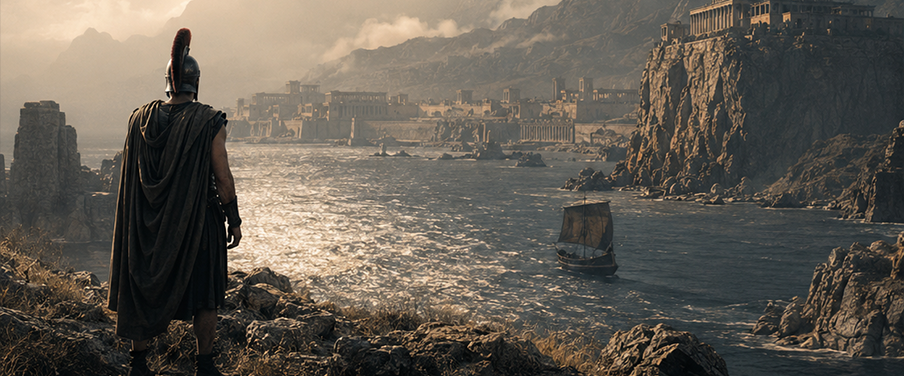
Another defining characteristic of The Odyssey is its commitment to real environments.
The production travelled across locations including Greece, Italy, Morocco, Iceland, Scotland, Malta and Western Sahara, using landscapes and historical locations to establish the scale and identity of the ancient world.
Troy, for example, was built around Aït Benhaddou in Morocco, while the Cyclops sequence was filmed at Nestor’s Cave in Greece.
For a VFX artist, a real location is more than a beautiful background.
It is a complete lighting reference.
It contains real atmospheric depth.
It provides natural textures.
It gives the camera physically accurate reflections, shadows and perspective.
And when digital extensions or creatures are eventually introduced, those real-world elements become the foundation that helps them belong in the same image.
This is why the relationship between location photography and VFX is so important.
The more convincing the photographed world is, the more convincing the invisible work can become.
Firelight, Recreated Through Technology
Perhaps one of the most technically intriguing ideas is the approach to the film’s firelight.
For the fall of Troy, the production wanted the environment to be driven by the visual behaviour of real flames.
But large-scale open fire presents obvious challenges for filmmaking: exposure, safety, consistency and controllability.
The production therefore developed more than 1,000 custom four-foot LED panels, programmed to reproduce the flicker and behaviour of firelight across large areas.
This is a perfect example of the distinction between practical filmmaking and digital filmmaking becoming increasingly irrelevant.
The solution is technological.
But the goal is realism.
The technology exists to reproduce something that audiences already understand intuitively: the unpredictable movement of firelight.
That is smart visual engineering.
Nolan Isn’t Avoiding VFX. He Is Repositioning It.
This is perhaps the biggest misconception worth addressing.
Nolan’s preference for practical filmmaking is sometimes reduced to the idea that his films are made “without VFX.”
That isn’t accurate.
The Odyssey has a substantial visual-effects component, with DNEG serving as the film’s sole VFX partner, led by production VFX supervisor Andrew Jackson and VFX supervisors Andrew Lockley and Giacomo Mineo.
And that is exactly what makes the film interesting from our perspective.
The question isn’t:
“Practical effects or CGI?”
The better question is:
“What should be real, what should be digital, and how can both work together?”
A physical creature can provide performance and interaction.
VFX can extend its scale.
A real location can provide the photographic foundation.
Digital environments can expand it.
A practical prop can create authentic contact and lighting.
CG can remove limitations that the camera cannot physically overcome.
That is the modern VFX pipeline at its most effective: not replacing reality for the sake of technology, but extending reality when the story requires it.
The New Frontier Is the Integration
For us at Digikore Studios, this is perhaps the most valuable takeaway from The Odyssey.
The future of visual effects is not necessarily about making everything digital.
It is about making the boundary between practical effects, special effects, cinematography and VFX increasingly seamless.
The film demonstrates a production philosophy where these departments are not treated as isolated stages.
Nolan has specifically discussed having the practical-effects and visual-effects leadership collaborate from the design stage and throughout production.
That approach changes the entire process.
Instead of asking the VFX team to fix a problem after the footage has been captured, the production can design the shot from the beginning with VFX integration in mind.
That means better plates.
Better lighting references.
Better camera information.
Better performances.
Better continuity.
And ultimately, more believable images.
What Makes The Odyssey a Masterclass in Visual Storytelling?
For us, it isn’t simply the size of the film.
It is the discipline behind that size.
A 60-foot creature.
A 35-foot Trojan Horse.
Massive physical environments.
Real oceans and locations.
New camera technology.
Forced perspective.
Practical lighting solutions.
Creature work.
Digital augmentation.
And an enormous VFX pipeline working behind the scenes.
None of these techniques matter individually if the audience becomes aware of the technique instead of the story.
That is the real achievement.
The best visual effects don’t necessarily announce themselves.
They make the impossible feel inevitable.
They make a mythical creature feel like it occupies the same physical world as the actor.
They make a digital environment feel photographed.
They make an ancient civilisation feel tangible.
And they make technology disappear into storytelling.
What We Take Away at Digikore Studios
At Digikore Studios, we see The Odyssey as a fascinating example of where filmmaking is heading.
Not toward a world where VFX replaces practical filmmaking.
And not toward a world where practical effects replace digital artistry.
But toward a more integrated approach where VFX, CGI, practical effects, cinematography, lighting, production design and emerging technology are planned together.
The real innovation isn’t simply creating something spectacular.
It is figuring out the most convincing way to create it.
And sometimes, that means building a 60-foot creature.
Sometimes it means developing a new camera solution.
Sometimes it means travelling halfway around the world.
And sometimes it means using a digital effect so subtly that the audience never realises it was there.
That, ultimately, is what makes The Odyssey such an interesting film to study.
Not because it rejects technology.
But because it understands that technology is most powerful when the audience forgets it is looking at technology at all.
At Digikore Studios, we believe the future of visual storytelling isn’t about choosing between real and digital.
It’s about knowing when to use each—and making them feel like one world.