
Introduction
From ancient kingdoms and futuristic cities to breathtaking alien planets, some of cinema’s most memorable locations have one thing in common: they never existed in the real world.
Yet when audiences watch these scenes, they rarely question whether the location is real. Every mountain range, skyline, castle, or distant horizon feels like a natural part of the story.
This is the magic of digital matte painting, a visual effects technique that creates realistic environments beyond the limits of physical locations.
Although it often goes unnoticed, digital matte painting plays a significant role in modern filmmaking, helping storytellers transport audiences to places that cameras alone could never capture.
What Is Digital Matte Painting?
Digital matte painting is the art of creating or enhancing environments using digital imagery.
Rather than constructing massive sets or travelling to remote locations, filmmakers can extend landscapes, add architectural details, or create entirely fictional worlds that appear seamlessly within live-action footage.
Think of it as painting with realism in mind.
The goal isn’t to create artwork that looks painted. Instead, it’s to create environments so convincing that audiences believe they were filmed on location.
Whether it’s an ancient fortress overlooking a valley or a futuristic skyline stretching beyond the horizon, digital matte painting helps transform imagination into believable cinematic worlds.
Why Is Digital Matte Painting Important?
Every story has a world.
Sometimes that world exists in reality. More often, it doesn’t.
Building enormous sets for every location would be expensive, time-consuming, and often impossible. Even finding the perfect natural location isn’t always practical.
Digital matte painting gives filmmakers creative freedom.
It allows stories to unfold in places that couldn’t otherwise exist, without compromising realism.
This flexibility enables filmmakers to recreate historical cities, imagine distant planets, expand real landscapes, or subtly enhance existing locations, all while maintaining visual consistency.
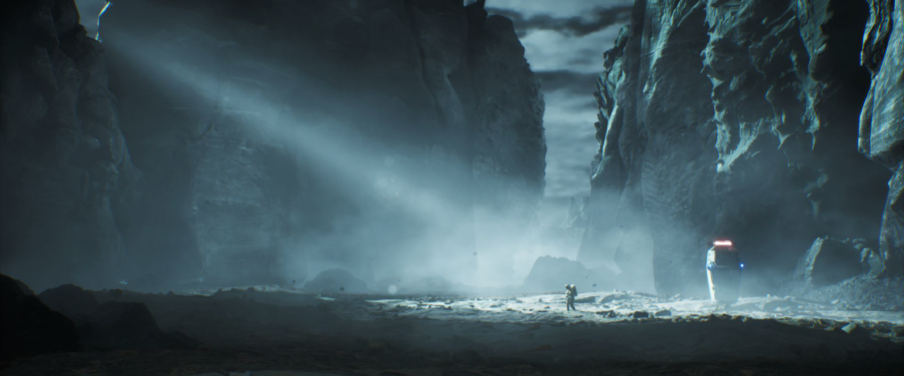
It’s More Common Than You Think
Many people associate digital matte painting with fantasy or science fiction films.
While those genres certainly rely on it, the technique is used far more widely.
Historical dramas use it to remove modern buildings and recreate cities from centuries ago.
Adventure films use it to extend landscapes and create dramatic mountain ranges.
Television series use it to build castles, kingdoms, and large-scale environments that would be impractical to construct physically.
Even commercials and corporate videos often rely on digital environment enhancements to achieve polished visuals.
In many cases, viewers never realize they’re looking at digitally created scenery.
Creating Bigger Worlds Without Bigger Sets
Imagine filming an actor standing on the balcony of a medieval castle.
The balcony may be physically built, but everything beyond it- the towering mountains, the sprawling kingdom, the distant villages, and the dramatic skies- can be created digitally.
The audience experiences one continuous world, even though only a small portion actually existed during filming.
Digital matte painting allows productions to achieve cinematic scale without building every element in the real world.
This not only expands creative possibilities but also makes ambitious storytelling more practical.
Realism Is the Goal
The success of a digital matte painting isn’t measured by how artistic it looks.
It’s measured by whether anyone notices it at all.
The best matte paintings blend naturally with live-action footage, matching the mood, atmosphere, and visual style of the scene.
When done well, audiences simply accept the environment as real.
Their attention stays on the story, not on how the scene was created.
Supporting Storytelling
Great visual effects are never just about spectacle.
They’re about helping stories feel authentic.
A lonely castle surrounded by endless snow instantly communicates isolation.
A futuristic skyline suggests technological advancement.
An ancient city tells audiences they’re stepping into another era.
Digital matte painting helps establish these settings, giving stories a strong sense of place while supporting the emotions each scene is meant to evoke.
It’s not simply about creating beautiful images, it’s about creating believable worlds that enhance the narrative.
Where You’ll Find Digital Matte Painting
Today, digital matte painting is used across a wide range of productions, including:
- Feature films
- Streaming series
- Television productions
- Commercials
- Historical documentaries
- Fantasy and science fiction projects
- Architectural visualizations
- Theme park and immersive experiences
Its versatility makes it one of the most valuable tools in modern visual storytelling.
The Bigger Picture
Every memorable story takes audiences somewhere.
Sometimes that destination is a real location. Other times, it’s a place that exists only in imagination.
Digital matte painting bridges that gap.
By combining creativity with visual realism, it enables filmmakers to build worlds that feel authentic, immersive, and emotionally engaging.
For audiences, these environments simply become part of the story.
For visual effects artists, they represent one of the many ways imagination is transformed into cinematic reality.
Conclusion
Digital matte painting is one of the quiet strengths of modern visual effects.
While audiences may remember the epic battles, breathtaking landscapes, or futuristic cities, they rarely realize how many of those environments were carefully crafted behind the scenes.
It’s a reminder that the most effective visual effects aren’t always the most obvious—they’re the ones that make the impossible feel completely real.